Home
We are recruiting! The Shin Group has openings for postdoctoral associates and incoming/current PhD students.
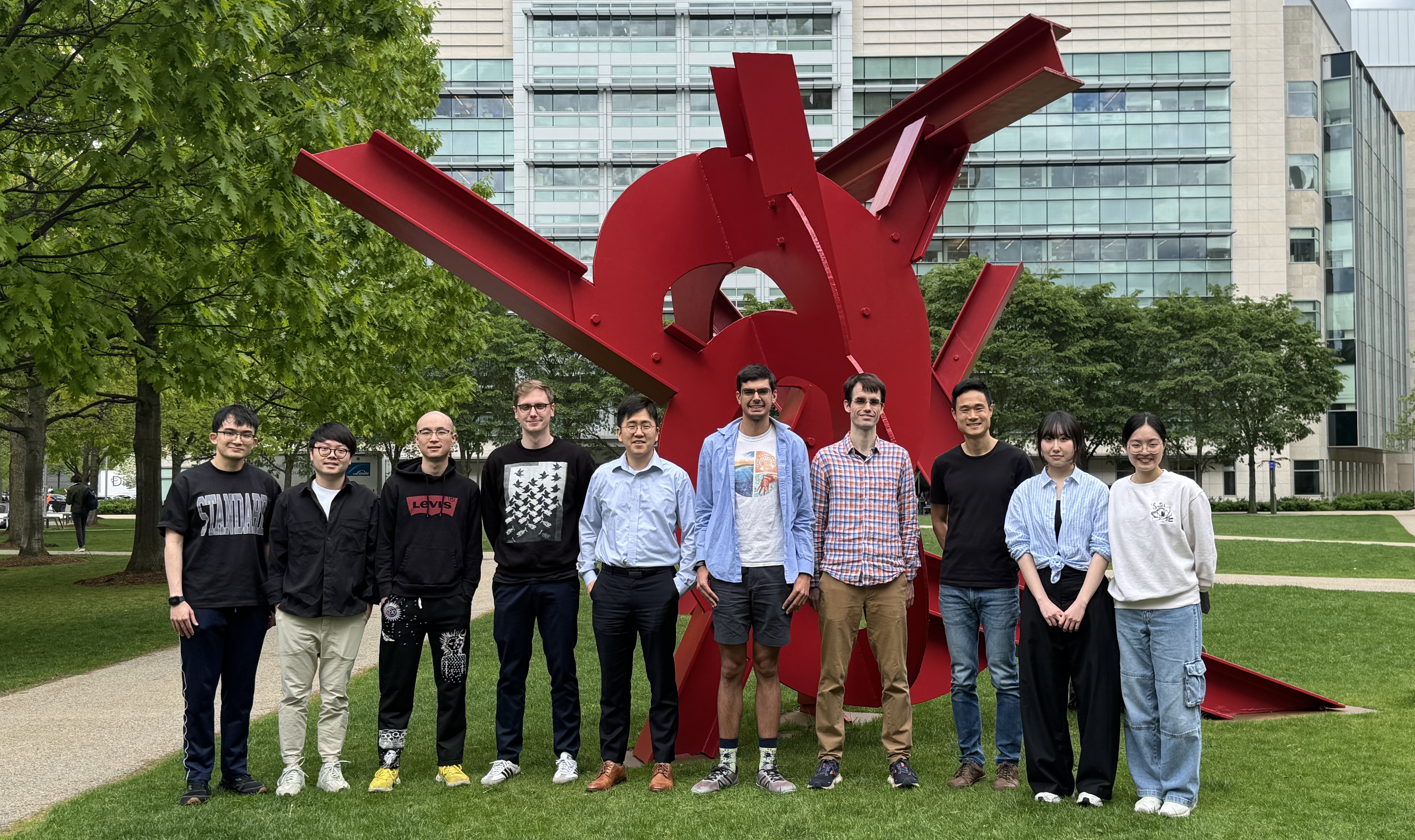
Welcome to the Shin Group’s website! We are a research group at the Massachusetts Institute of Technology, led by Professor Sungho Shin.
Group Overview
Our research group is dedicated to tackling the mathematical, computational, and practical challenges involved in making systematic decisions in complex systems. We strive to make contributions in the fields of mathematical optimization, control theory, machine learning, process systems engineering, and energy systems.
Here are some of our specific research interests:
- Developing scalable algorithms capable of addressing challenging decision-making problems in various engineering and societal domains.
- Advancing our understanding and developing algorithms for machine learning methods in control problems.
- Building computational infrastructure for scalable and data-driven decision-making by harnessing the capabilities of modern high-performance computing, particularly through the use of GPU computing.
- Making tangible impacts in decision-making practices within the domains of process systems engineering and energy systems by introducing new modeling paradigms, algorithms, and software tools.
Learn more about our research >>
News
| Sep 2026 | Our paper "Harnessing GPU Acceleration in Large-Scale Process Optimization" (with Boxun Huang, David Yang Shu, Michel Schanen, and Rahul Gandhi) was accepted at FOCAPO/CPC 2027. | |
| Sep 2026 | Our paper "Design of Carbon Capture Processes Under Part-load Operating Conditions" (with David Yang Shu, Boxun Huang, Yurim Kim, Randall Field, and Rahul Gandhi) was accepted at FOCAPO/CPC 2027. | |
| Sep 2026 | Our paper "Revisiting simultaneous methods for dynamic optimization in the GPU era" (with Joseph W. Choi) was accepted at FOCAPO/CPC 2027. | |
| Sep 2026 | Our preprint "Reliability Value of Long-Duration Energy Storage against Extreme Events in High-Renewable Grids: A Full-Year AC-OPF Assessment" (with Jeongdong Kim and Jonggeol Na) is available on arXiv (2609.06864). [ Link ] | |
| Aug 2026 | Sungho presented "GPU Acceleration in Optimization and Optimal Control," a half-day pre-congress workshop at the 23rd IFAC World Congress (BEXCO, Busan, 23 August 2026), covering GPU-accelerated nonlinear optimization and optimal control with ExaModels.jl and MadNLP.jl. [ Link ] |